October in New York: three verbs at Pace, a drawing machine on West 25th Street, pencil on kitchen foil on Walker Street, and the Met asking who authorized the picture of the East.
Chelsea walk is the one — five shows, one of four for October 2026.
01 A List of
Verbs
Benglis titles her survey with three verbs, and the walk around it follows them out the door: mesh knotted and pleated at Pace, a building’s louvre remade at Lehmann Maupin, one pour of paint a day at Berry Campbell, a key cut from a blank at Zwirner.
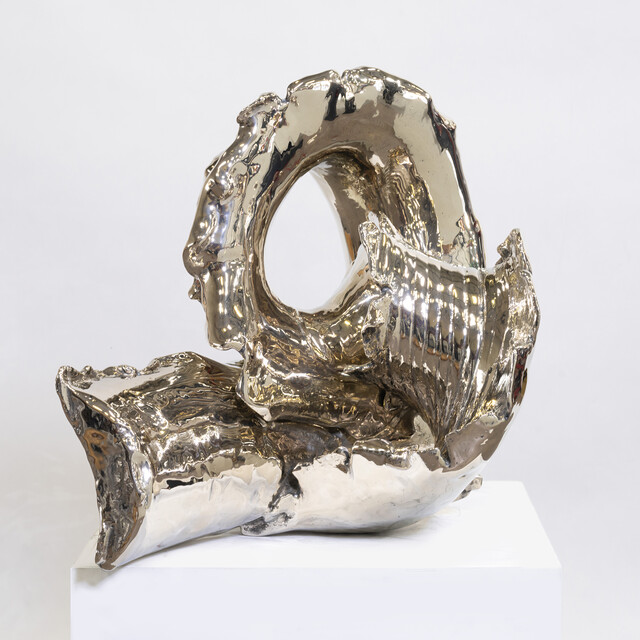
Lynda Benglis’s survey at Pace is titled with three verbs, Knotting, Tying, Folding, and the title is the method. Nothing in the show begins with an image. It begins with stock material from the hardware aisle, wire mesh and chicken wire, and an operation anyone could perform on it. The earliest piece, Sparkle Knot IV (1972), is a knotted tube of wire mesh covered in plaster, paint and glitter. The pleated wall works fold the same mesh into accordions and finish it in gold leaf or sprayed metal until the operation and the ornament are hard to pull apart.
This walk follows that idea out the door, because three other shows on it are built the same way: a plain procedure, applied to an ordinary thing, and left legible. Rana Begum’s Louvre series at Lehmann Maupin starts from a part every building already has, the slatted panel of a vent or a blind, and remakes it in metal, stone and glass to see what it does to light. Susan Vecsey at Berry Campbell paints to a schedule: one pour of thinned oil a day on each canvas, a painting arriving over two or three months. Nate Lowman at Zwirner paints keys, the one object whose whole meaning sits in its cut profile.
None of this is a shared style. What these artists share is a working habit: each lets the operation show. In every gallery the thing to look at is what was done, in what order, to what common material. Benglis and Lowman carry the argument hardest. Begum is the most architectural and the most dependent on daylight. Vecsey’s rule is the gentlest and asks for the slowest looking. First Street’s group show, observational painting with no rule in sight, works as the counterweight at the end.
Read the full walk →- 01Nate LowmanDavid Zwirner · 519 W. 19th StreetCloses Oct 24
- 02Rana BegumLehmann Maupin · 501 W 24th StreetCloses Oct 24
- 03Lynda BenglisPace Gallery · 540 West 25th StreetCloses Oct 24
- 04In FocusBerry Campbell Gallery · 524 W 26th StreetCloses Oct 24
- 05MUSINGS | What is Seen and What is Not – Part IIFirst Street Gallery · 547 West 27th StreetCloses Oct 24
02 Learning the
Language
Three artists who learned a dominant visual language from outside it: Osman Hamdi Bey in the Met’s Orientalism, then two shows in one building on East 66th Street, Cossette Zeno arriving in Breton’s Paris at Richard Saltoun and Esphyr Slobodkina helping found American abstraction at Rosenberg & Co.
Read →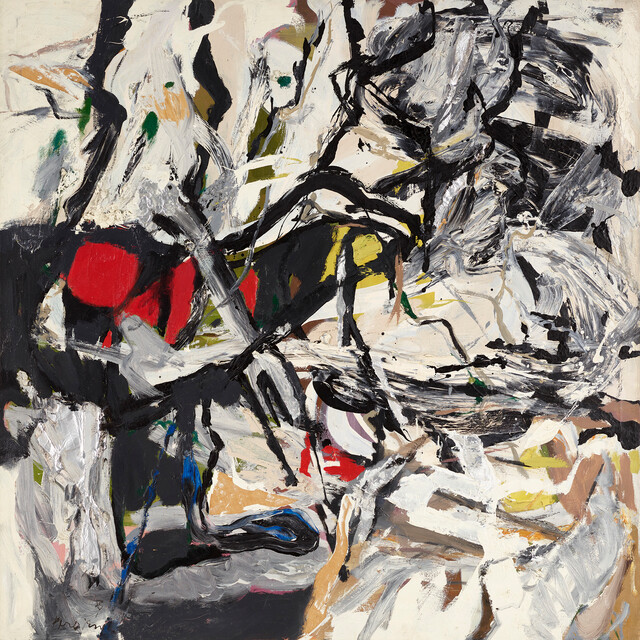
03 The Rule and
the Remembering
What happens between an instruction and its result: Harold Cohen’s drawing machine at Gazelli, Matthew Ronay’s plinths built from a misremembered Frank Lloyd Wright fireplace, Eric Uhlir scraping half of every painting away, and Perle Fine’s gesture laid over a lifelong grid.
Read →
SoHo / TriBeCa +1
04 Kitchen Foil and
Bone Black
Four stops tied together by their humblest materials: Maggi’s pencil on kitchen foil, McIntyre’s pours over bone black and bubble wrap, Wilkinson’s bare linen standing in for painted linen, and eighteen artists over seventy-five at Marc Straus who are still making new work.
Read →