02 Where You Choose to Stand
Sixty-three artists solving the same spatial problem sixty-three ways — landscape not as a subject but as a stance. An easy uptown afternoon on framing as a decision.
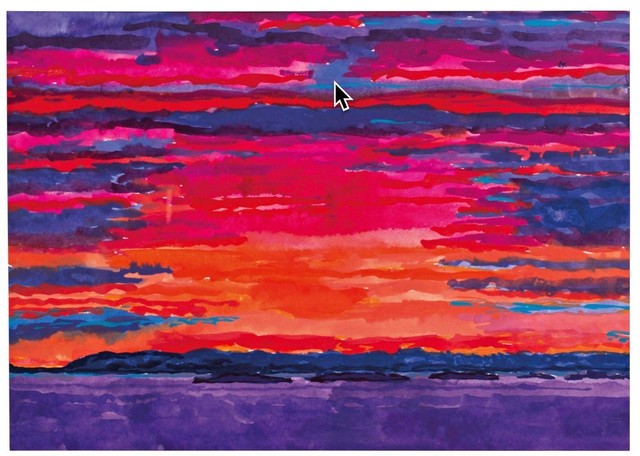
A landscape looks like a subject, but it’s really a decision: where to stand, where to put the horizon, what to leave out. This walk takes that decision as its theme. Alpha 137’s sixty-three-artist survey up in Harlem gathers a Pop-and-after who’s-who — Ruscha, Hockney, Lichtenstein, Warhol, Christo, Jonas Wood, with Marsden Hartley and Wolf Kahn holding the lyric-landscape end — and hangs them together precisely so the taxonomy shows through. Seen one at a time, each is just a picture; seen sixty-three at once, they reveal ’landscape’ as a set of framing choices, the same moves a section drawing makes. The Met’s Musical Bodies takes the theme into the body, asking how the human form gets fitted to the instrument, and the Rosenberg survey of American abstraction strips the landscape away entirely to leave only the framing gesture itself. The through-line is the architect’s question underneath every image: not what is depicted, but where the maker chose to stand. An easy loop from Upper Manhattan to the Upper East Side.
- 01The Shape of ThingsRosenberg & Co. · 19 E 66th StCloses Sep 30
- 02Musical BodiesMetropolitan Museum of Art · 1000 Fifth AvenueCloses Sep 27
- 03Landscapes, Cityscapes, Waterscapes and SkyscapesAlpha 137 Gallery · 251 West 123rd StCloses Sep 27
Landscapes, Cityscapes, Waterscapes and Skyscapes
A sixty-three-artist survey of prints, multiples, and works on paper organized around a single deceptively simple idea — the world seen from a distance and framed — running from Wolf Kahn and Marsden Hartley through the full Pop-and-after canon.
Ruscha, Hockney, Lichtenstein, Warhol, Rauschenberg, Christo, Jonas Wood, Maya Lin, April Gornik, Lois Dodd and dozens more, gathered by the loose organizing principle of landscape across every register — city, water, sky. Up in Harlem, open through late September.
Don’t go for any single work; go for the taxonomy. A survey this size makes visible something you’d never catch one canvas at a time: that ’landscape’ isn’t a subject, it’s a stance — a decision about where to stand and how much to leave out. Ruscha’s deadpan horizontals and Christo’s wrapped interventions and Hartley’s brooding Maine hills aren’t really the same genre; they’re sixty-three different answers to the same spatial problem, and hanging them together turns the wall into a comparative diagram.
For you the architect’s version of the question is unavoidable here. Every one of these is a framing problem before it’s a picture. What gets cropped, what gets centered, where the horizon sits, how much sky you grant — these are the identical moves a section drawing makes, the same decisions about aperture and threshold and what to exclude so the essential thing reads. Maya Lin’s presence in the roster is the tell: land art and the section cut are the same discipline of choosing a datum and framing what falls on either side. Worth an hour uptown to watch sixty-three people solve one spatial problem sixty-three ways. No rush — open through late September.
The month’s clearest architecture lesson — every landscape is a framing decision before it’s a picture.
Musical Bodies
The Shape of Things