03 Who Gets to Draw the Map
The Met’s first show on Orientalism, from Napoleon’s Egypt to an Ottoman painter who turned the gaze back around. An Upper East Side afternoon about who holds the pen when one culture pictures another.
Every image of ’the East’ was also an argument about power, and this walk follows that argument to its source. The Met’s Orientalism: Between Fact and Fantasy is the museum’s first show on the subject, and it doesn’t flinch: it opens with Napoleon’s 1798 conquest of Egypt and traces how Islamic objects flowed to European dealers, expositions, and museums, becoming raw material for a new visual language. One of its four sections is titled, flatly, ’Hard and Soft Power’ — orientalism as design, the world’s fair as instrument of empire. That is spatial justice and political economy made visible on a wall: who extracts, who displays, who gets classified as ’type’ rather than portrait. The show closes with Osman Hamdi Bey, the Ottoman painter who learned the European idiom and turned it back around — the colonized subject seizing the brush. Giacometti’s spare figures, installed inside the Temple of Dendur a few galleries away, sharpen the question of how bodies get staged in borrowed space. The walk asks the hardest version of the authorship question: not who made the picture, but who authorized it, and at whose expense.
- 01Summertime and All That JazzDebra Force Fine Art · 13 East 69th StreetCloses Sep 11
- 02Metropolitan Museum of Art1000 Fifth Avenue · 2 shows
- Orientalism
- Giacometti in the Temple of Dendur
Orientalism
A four-gallery exhibition curated jointly by the Met’s Islamic Art and European Paintings departments — the first time either has taken Orientalism as its central subject, with roughly 180 objects spanning painting, textiles, arms, glassware, and architecture.
The show runs from Napoleon’s 1798 Egyptian campaign to the Ottoman painter Osman Hamdi Bey, organized into sections including ’The Alhambra: Gateway to Orientalism,’ ’Hard and Soft Power: Orientalism and Design,’ and ’Facing the Orient.’ Gérôme, Delacroix, and Ingres hang beside the Islamic objects they used to stage their fantasies.
This is the show of the month for you, and not for the paintings — for the argument the installation is willing to make about them. Edward Said’s Orientalism (1978) is the ghost in every gallery: his claim that ’the Orient’ was never a place so much as a European projection, a body of knowledge produced to justify governing it. The genius of the Met’s framing is that it doesn’t just illustrate Said, it complicates him — by hanging the Gérômes and Delacroix beside the actual Islamic objects that circulated through world’s fairs and dealers’ shops, it makes the traffic visible. You can see the extraction happening: a real ceramic, a real textile, lifted out of its life and repurposed as set dressing for a fantasy of the East.
The section that should stop you is ’Hard and Soft Power: Orientalism and Design.’ It reads the 19th-century world’s fair as an instrument — the exposition as a machine for classifying cultures, ranking them, staging the colonized world as a picturesque supplier of handicraft while the industrial West claims the future. That is political economy rendered as spectacle, and it is the exact architecture-of-power question you spend your professional life inside: who builds the frame, who gets displayed within it, and how the frame pretends to be neutral while doing the sorting. The wall text’s move from ’portrait’ to ’type’ in the ’Facing the Orient’ section is the whole colonial epistemology in two words — the individual dissolved into a category so the category can be governed.
And then Osman Hamdi Bey at the end, refusing to resolve cleanly. An Ottoman trained in the French academy who painted his own world in the colonizer’s idiom — is that resistance, appropriation, or both at once? He’s the crack in the binary, the subject who picked up the pen. Sit with how uncomfortable the show is willing to be. It doesn’t offer absolution. Runs through February, so no deadline pressure — but it rewards a slow, argumentative hour.
The month’s sharpest edge — image-making as an instrument of empire, and the question of who holds the pen.
Giacometti in the Temple of Dendur
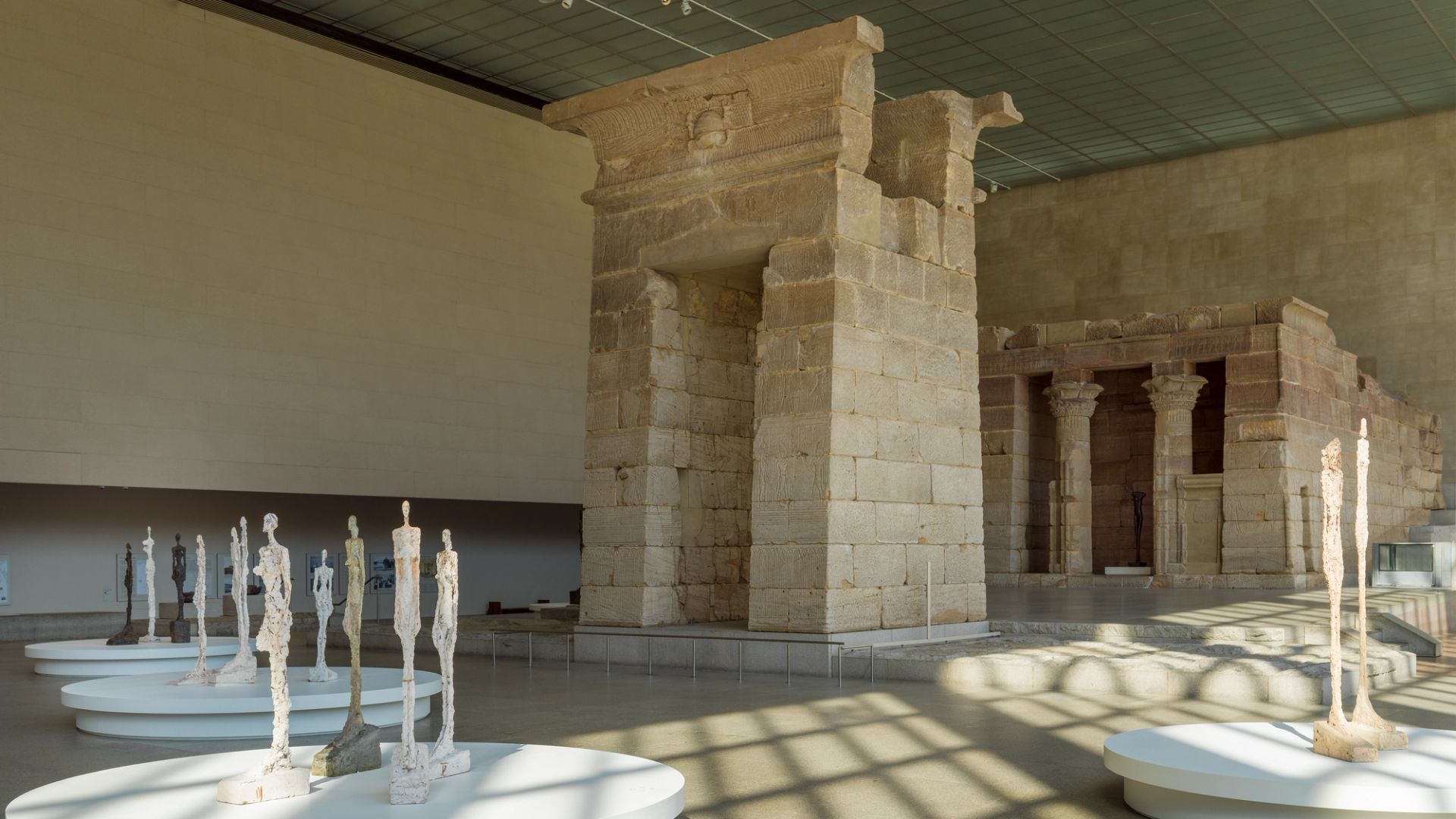
Alberto Giacometti (1901–1966), the Swiss sculptor whose attenuated bronze figures became the postwar emblem of the human stripped to its irreducible core — presence rendered as thinness, as distance.
A focused installation of Giacometti’s elongated figures set inside the Met’s Temple of Dendur gallery — modernist bronze staged against a 2,000-year-old Egyptian temple relocated stone by stone to Manhattan.
The interest here is entirely spatial, which is why it belongs on this particular walk. The Temple of Dendur is itself an Orientalist object in the deepest sense: an Egyptian sanctuary disassembled, shipped, and reassembled inside a glass box on Fifth Avenue, its meaning wholly rewritten by the space it now occupies. Drop Giacometti’s spare figures into that room and you get a collision of two kinds of displacement — the ancient temple wrenched from the Nile, the modern figure wrenched down to almost nothing.
Giacometti’s whole project was distance: his figures look far away even when you’re standing right in front of them, because he was sculpting the experience of seeing a person across a room, the gap that never fully closes. Set that against the temple’s monumental permanence and you feel the argument in your body — the thin, provisional human against the massive, relocated stone. For an architect, this is a lesson in how radically installation authors meaning. Nobody painted or carved a new thing; a curator simply decided where two existing things would stand in relation to each other, and the relation did the rest. Closes September 8, so it has a real, if gentle, clock on it.
Meaning authored by placement — two displaced objects, and the space that rewrites them both.