04 The Category-Breaker
MoMA’s first Duchamp retrospective in fifty years — the man who let chance and wit dismantle what counts as art at all. A Midtown afternoon on the artist who made authorship a question.

For fifty years no North American museum staged a full Duchamp retrospective, and now MoMA has — which makes August the month to reckon with the artist who spent his life dismantling the categories everyone else took for granted. In Advance of the Broken Arm is a snow shovel; Fresh Widow is a window that refuses to open; 3 Standard Stoppages preserves three threads dropped by chance and calls the result a unit of measurement. Each is a small bomb planted under the assumption that the artist’s authorizing hand is what makes a thing art. Duchamp handed that authority to accident, to the hardware store, to the pun. Upstairs, Hilma af Klint offers the century’s other refusal — abstraction painted years before the men who got the credit, made not for a gallery but at the instruction of what she believed were higher powers, and left deliberately unseen for decades. Two artists, one question: what has to be true for a made thing to count, and who gets to decide? The walk runs Midtown, cool museum interiors, an afternoon for the mind more than the feet.
- 01Summer in the CityGemini G.E.L. at Joni Moisant Weyl · 535 West 24th StreetCloses Sat Aug 15
- 02Museum of Modern Art11 West 53rd Street · 2 shows
- Marcel Duchamp
- Hilma af Klint
Marcel Duchamp
Marcel Duchamp (1887–1968), the French-American artist whose readymades and chance operations detonated the definition of art in the 20th century and set the terms for nearly everything conceptual that followed.
The first major North American Duchamp retrospective in over fifty years, organized by MoMA with the Philadelphia Museum of Art and the Centre Pompidou. Fresh Widow, In Advance of the Broken Arm, Network of Stoppages, and the chance-generated 3 Standard Stoppages anchor a career-length survey of an artist who turned ordinary things, accident, and linguistic wit into tools for remaking art.
The stakes of this show are unusually clean, and they’re exactly your stakes: Duchamp is the origin point of the question ’what counts as art, and who decides?’ Before him, the answer was roughly ’the skilled authorizing hand of the artist.’ He spent a lifetime demonstrating that the answer is closer to ’a frame, a signature, an institution, and a viewer willing to play along.’ A snow shovel bought from a hardware store (In Advance of the Broken Arm) becomes art because he says so and MoMA agrees — which exposes the whole apparatus of authorization that usually stays invisible. This is Wittgenstein’s territory rendered in objects: the meaning of ’art’ isn’t in some essence the shovel possesses, it’s in the use, the language-game, the institutional practice that surrounds it. Duchamp is doing philosophy of language with a bottle rack.
Don’t miss 3 Standard Stoppages, because it’s the piece that should genuinely rewire how you think about your own work. In 1913 Duchamp dropped three meter-long threads onto canvas and fixed them where they landed, then treated those chance curves as a new, personal unit of measurement — a standard authored by accident rather than decree. Think about what that does to the meter, to the grid, to every ’objective’ measure a designer relies on: it reveals the standard as a convention someone once chose, not a fact of nature. For a builder who works in dimensions and modules all day, this is a small, permanent crack in the floor. The retrospective closes August 22 — a real deadline — so this is the show to prioritize if the month gets away from you.
The root of the whole month’s question — authorship dissolved into frame, chance, and institutional say-so.
Hilma af Klint
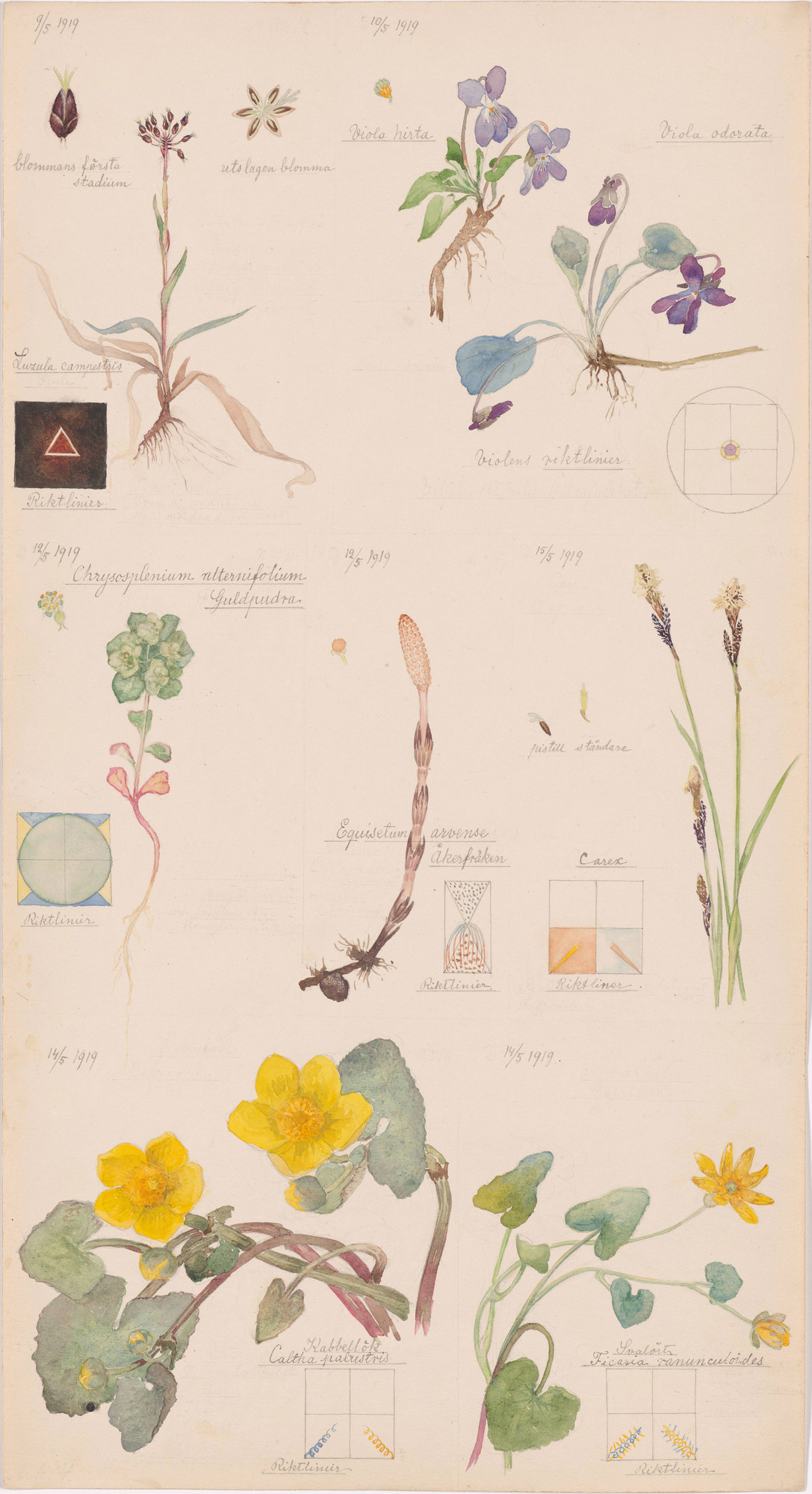
Hilma af Klint (1862–1944), the Swedish painter who made large-scale abstraction years before Kandinsky, Mondrian, or Malevich — and asked that it stay unseen until the world was ready.
A focused exhibition centered on af Klint’s botanical work — What Stands Behind the Flowers — pairing her systematic studies of plants with the esoteric, diagrammatic abstraction that grew out of them. Made partly at the instruction of what she described as spiritual guides, and withheld from public view for decades by her own instruction.
Af Klint is the perfect foil to Duchamp downstairs, and the pairing is the reason this itinerary holds together. Where Duchamp dismantled authorship by handing it to chance and the hardware store, af Klint complicated it from the opposite direction — she claimed she wasn’t the author at all, that the paintings were dictated to her by higher powers, and that they should be hidden until humanity could understand them. Both are refusals of the heroic-genius model, arriving from opposite poles: Duchamp’s ironic, af Klint’s devotional.
The botanical framing here is the part that should land for you. These aren’t loose flower studies — they’re systematic, almost taxonomic diagrams, plants observed with a scientist’s rigor and then abstracted into geometry, color-coded, annotated like a technical drawing. It’s the same impulse that runs through your own discipline: the move from observed nature to notation to system, the belief that behind the visible form there’s a diagram you could draw. ’What stands behind the flowers’ is her question and it’s a designer’s question — what is the underlying order, and can it be made visible? She was building a visual language for the invisible structure of things, decades before anyone would look. Runs through late September, so it’s the unhurried half of the walk.
Authorship refused from the opposite pole — the diagram behind the visible, made and then deliberately hidden.