02 Nothing Dictated From Above
A loop within a couple blocks of 66th & Park. The through-line: none of this work takes its orders from above.

Four rooms within a few blocks of each other, held together by a single refusal: none of this work takes its orders from above. Céleste Boursier-Mougenot fills the Armory’s drill hall with sound that no composer wrote — porcelain bowls drifting on water, colliding by chance, the music left to physics and accident. The title, Clinamen, is Lucretius’ word for the atom’s unpredictable swerve, the tiny deviation that lets a universe assemble itself without a hand guiding it. A few steps away, Giacomo Manzù spent a career finding the sacred without doctrine — his bronze cardinals carry authority through gesture and form, not the Church’s script. Around the corner, Rafael Ferrer answers empire in the vernacular: Puerto Rican, Afro-Caribbean, improvised, refusing every fixed category the mainland tries to impose. And Salon d’Eté lets the walk exhale — a summer room where you’re simply allowed to look. Meaning here rises from the material, the body, the street. An easy loop between Park and Madison, cool interiors, an afternoon that asks where authority actually comes from.
- 01C�leste Boursier-MougenotPark Avenue Armory · 643 Park AveCloses Aug 2
- 02Giacomo ManzùRosenberg & Co. · 19 E 66th StCloses Jul 17
- 03Rafael FerrerHenrique Faria Fine Art · 35 East 67th StreetCloses Jul 17
- 04Salon d’EtéOpera Gallery · 827 Madison AvenueCloses Aug 12
C�leste Boursier-Mougenot
French artist and composer who turns the movement of everyday objects into self-generating sound environments — music with no score, authored by physics rather than a hand.
In the Wade Thompson Drill Hall, hundreds of white porcelain bowls float on a vast pool. Slow currents push them; they drift, collide, and ring like chimes. Nothing is composed, nothing repeats, nothing can be predicted.
The title is the whole argument. Clinamen is Lucretius’ word for the swerve — the minimal, causeless deviation of a falling atom that, in De Rerum Natura, is the only thing keeping the universe from being a dead machine of parallel lines. Epicurus had imagined all matter raining downward through the void in straight, parallel paths. But if that were the whole story, nothing would ever touch anything else — no collisions, no combinations, no world at all. So Lucretius added the swerve: an unpredictable, uncaused deviation, however slight, that lets one atom drift into another and sets everything in motion.
And here is the part that matters most — the part worth carrying through the whole afternoon. Lucretius didn’t introduce the swerve to explain physics. He introduced it to rescue free will. Think it through: if every atom falls in a fixed path and every collision is set in advance, then so is every thought in your head. Your sense of choosing would be an illusion; the will would be just weather, determined all the way down to the first instant of the universe. The clinamen is the crack in that determinism. A single uncaused deviation at the smallest possible scale, and suddenly the future is no longer fully written — the door to genuine choice is pried open. No swerve, no collision, no world, and no free will.
What Boursier-Mougenot does is build that entire argument out of water and porcelain. The currents are lawful; they obey physics. But the collisions — which bowl touches which, and when, and what note rings — never resolve into a pattern you could predict or repeat. You are literally standing inside a question about determinism and freedom, and you are hearing it. The piece lives in the exact middle ground where freedom has to live: neither pure clockwork nor pure chaos, but law plus swerve.
For an architect there’s a second door in the same room. This is the cleanest case of emergence you’ll see on a wall all year — order that arises from process rather than from a plan, form that the maker sets in motion but does not dictate. It’s the question sitting underneath generative design, underneath every system you build that’s meant to produce outcomes you didn’t specify in advance. Sit with it longer than feels necessary. The piece rewards the architecture of attention.
It sets the tempo for the whole afternoon — order without authority, a system that governs itself.
Giacomo Manzù
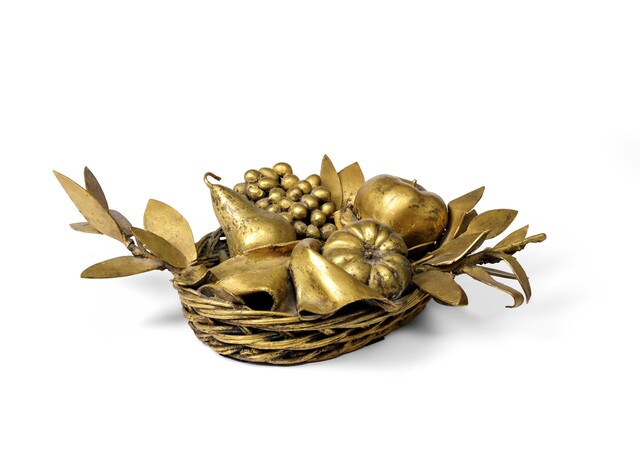
Italian sculptor (1908–1991), best known for bronze cardinals and religious figures rendered with formal elegance — the sacred approached through the body, not the catechism.
Manzù’s first New York show since 1985, built around his decades-long bond with dealer Alexandre Rosenberg. Sculpture, works on paper, and forty years of correspondence between two families. Standing Cardinal (1972) and Cestino, a gilt bronze basket of fruit, anchor the room.
Manzù spent a career rendering cardinals — the most doctrinal figures the Catholic Church has, men whose entire authority is inherited from above: from Rome, from scripture, from an unbroken chain of command. And he rendered them, in the words of the show itself, "not through doctrine but through form and gesture." That is the quiet radicalism here, and it’s why this room belongs on this particular walk. Manzù reaches the sacred without the Church’s script. He lets the fold of a bronze robe, the tilt of a seated body, the weight of a hand do what a catechism can’t. The gravity is real, but it rises out of the sculpture itself, not out of the institution the sculpture depicts.
Stand in front of Standing Cardinal (1972) and you feel it: the presence is bodily before it is religious. The authority is in the mass and the stillness, in a figure rendered with such formal certainty that he seems to generate his own gravity. Manzù believed the figure carried the meaning; the doctrine was, at most, the occasion. Next to Clinamen’s pure chance around the corner, this is the opposite pole — total control of the hand, nothing left to accident — and yet the two rooms are making the same argument. In both, meaning comes from below: from matter, from touch, from the thing itself. Never handed down.
The show’s real subject deepens that. It’s built around Manzù’s forty-year bond with his dealer, Alexandre Rosenberg — decades of correspondence between two families, laid out alongside the work. It quietly reframes the artist-dealer relationship, which we usually reduce to commerce, as something closer to devotion: trust, not transaction. Which is its own version of the theme — value that grows out of a relationship, earned over time, rather than assigned from above by a market.
Authority earned through gesture and trust, not inherited from doctrine or the market.
Rafael Ferrer
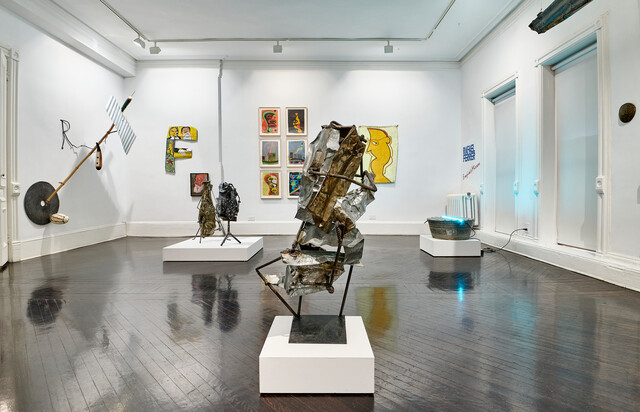
Puerto Rican artist (b. 1933), rooted in Afro-Caribbean rhythm, surrealist poetics, and jazz improvisation — a body of work that refuses every fixed category the art world hands it.
The title piece, Empire’s Mirror, is built from blackboard paintings carrying Ferrer’s own punditry on Puerto Rico’s colonial condition, resting on the insistence "that in humor lays truth." Hybrid, vernacular, improvised.
This is the political register of the walk’s question, and the room where the theme stops being a metaphor. "Nothing dictated from above" is a comfortable abstraction when we’re talking about atoms and bronze robes. Here the thing dictating from above is literally an empire. Ferrer is Puerto Rican; his birthplace is a territory whose laws, economy, and official story have been written elsewhere — from Washington — for well over a century. When power writes your story that completely, the question of who gets to author meaning stops being philosophical. It becomes survival.
So look at what Ferrer does with it. The title piece, Empire’s Mirror, is built from blackboard paintings — a humble, provisional surface, the kind of thing meant to be wiped and rewritten — carrying his own running commentary on the colonial condition. His whole practice draws on Afro-Caribbean rhythm, surrealist poetics, and jazz improvisation, and it refuses every fixed category the mainland art world tries to hand him. That refusal isn’t a stylistic tic. It’s the point. To accept the category is to accept the classification, and the classification comes from above.
His wager is that "in humor lays truth." Improvisation and wit become the way you write your story back from below — you can’t out-muscle an empire, but you can out-maneuver its seriousness, slip its categories, keep moving. It’s the sharpest, most alive room of the loop, and the one you’ll still be turning over on the train home. It’s what gives the whole walk its teeth.
The walk’s hardest edge — meaning authored from below, against a power that claims the right to define you.
Salon d’Eté
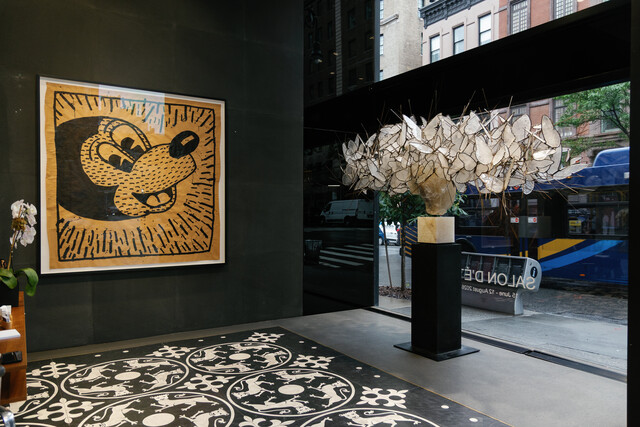
A rotating summer group show at a Madison Avenue gallery — many hands, no single author, chosen for the season.
A room organized around color, movement, and visual rhythm. No thesis, no argument — work selected to please the eye in July heat.
The lightest stop, and honestly the palate cleanser — and I’d rather be straight with you about that than dress it up. After the chance-physics of Clinamen, the devotional weight of Manzù, and the political heat of Ferrer, you’ll have been thinking hard for an hour. This is where the walk exhales. A summer group show organized around color, movement, and visual rhythm: no thesis, no argument, work chosen to please the eye in July heat.
Don’t come here hunting for depth. Treat it as the coda. Every good walk needs a stop where you’re allowed to just look — to let the eye rest and enjoy without decoding, which is its own underrated pleasure, and easy to forget after three rooms that demand interpretation.
And there’s a quiet reason it earns its place at the end. This is the one room on the walk where meaning more or less IS dictated from above — by a curator’s eye for what reads well and sells on a summer wall. It’s the counterexample that sharpens the other three. Having just spent an afternoon with work that generates its own authority from below, you’ll feel the difference the moment you walk in. Sometimes you understand a thesis best by standing, briefly, inside its opposite.
The exhale, and the counterexample — the one room where the eye is guided from above.