Palimpsest
Mehretu paints like cities are built — layer on layer, erasure on erasure.
This walk goes south and east, from Pier 36 through the Lower East Side into SoHo and TriBeCa. The theme is palimpsest — what’s underneath, what’s been erased, what bleeds through.
The anchor is Julie Mehretu at Marian Goodman Gallery. Her title alone is a philosophical position: *Our Days, Like a Shadow (a non-abiding hauntology)*. The Derrida reference is direct — hauntology names the condition where the past doesn’t stay buried but haunts the present, shaping it from underneath. Mehretu paints in layers: architectural drawing, cartographic notation, gestural abstraction, all on top of each other. Each layer partially erases the one below it. The result looks like a city seen from above — or like the inside of a mind trying to hold too many histories at once.
From there, walk to Marc Straus for Jong Oh — sculptures made of thread, metal, and acrylic that are so minimal they nearly vanish. If Mehretu is about accumulation and overflow, Oh is about subtraction and restraint. His work asks you to adjust your attention, to see what’s barely there.
Margaret Curtis at Post Times makes hyperdetailed paintings that Hyperallergic triple-flagged this month. Jessica Deane Rosner at McKenzie Fine Art offers intricate, small-scale drawings. Lucy + Jorge Orta at Jane Lombard work with textiles, food systems, and ecological networks. And the TAAG Gallery show at Pier 36 opens the walk at the waterfront.
This is the itinerary for a day when you want to think about layers — the layers of a painting, the layers of a city, the layers of history that shape the present even when you can’t see them.
THE RED CROWN
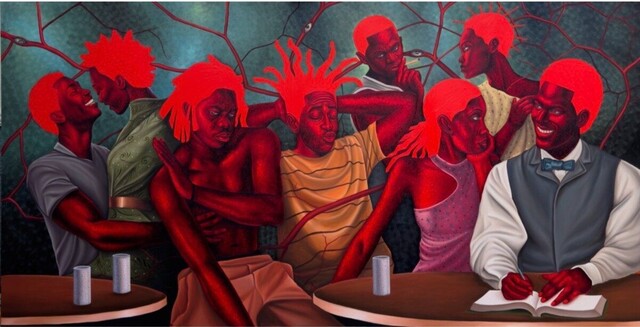
Wilson Imini is an emerging artist showing at TAAG Gallery at Pier 36. TAAG specializes in figurative painting and emerging voices.
THE RED CROWN presents figurative paintings — portraits and figure studies. Small gallery show at the waterfront. Closes today (April 19).
This show anchors the walk geographically — starts at the waterfront and moves north. Closing urgency makes it either the first stop or already gone.
Geographic anchor. Starts the walk at Pier 36, creates the southernmost point of the downtown loop. Intellectual connection is minimal — here for the route, not the argument. Honest about that.
Margaret Curtis
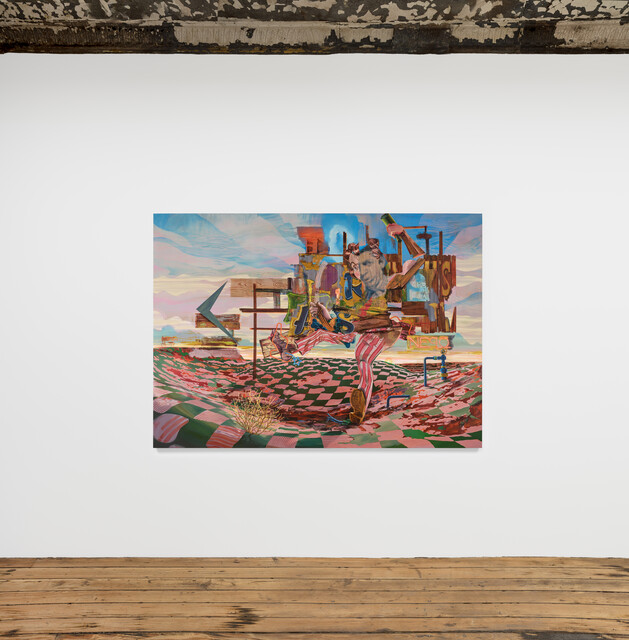
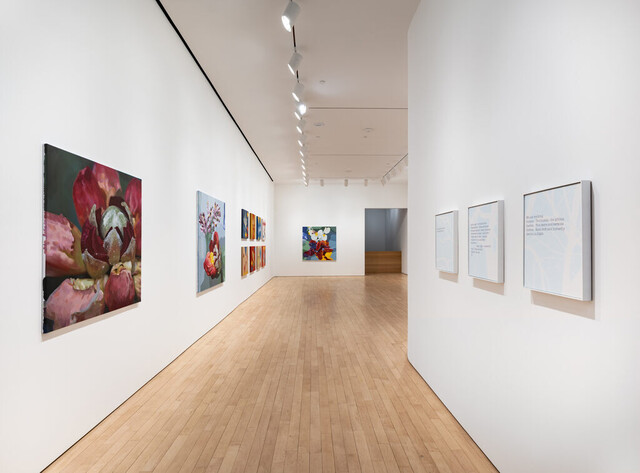
Margaret Curtis is an American painter working in hyperdetailed, photorealist-adjacent style.1 Hyperallergic flagged her three times this month — monthly picks, gallery listing, and artist feature. That level of editorial attention for a relatively unknown artist at a small gallery is a strong signal.
*’S* presents paintings at Post Times in the Lower East Side. The hyperdetailed style demands close looking — Curtis builds images slowly, accumulating detail until the surface becomes almost hallucinatory in its precision.
Hyperrealism as painting strategy is philosophical attention — it says: this thing deserves to be seen at a level of detail that photography normalizes but painting makes strange.
Critical-consensus anchor. The triple Hyperallergic flag is the strongest editorial signal on this walk. Curtis’s obsessive attention to surface connects to Gowin’s sustained attention on the Chelsea walk — both insist that looking harder reveals more.
Jessica Deane Rosner
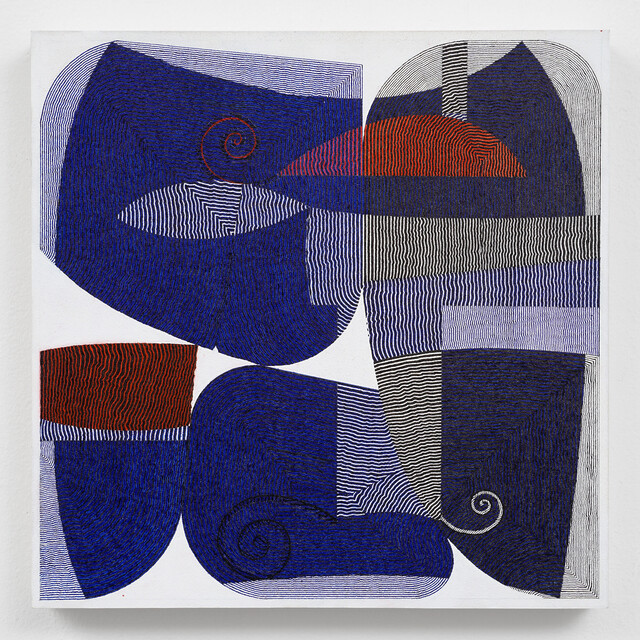
Jessica Deane Rosner is an American artist working primarily in drawing. McKenzie Fine Art on Orchard Street specializes in color-focused abstract and pattern-based work.
A Miscellany of Drawings presents intricate works on paper. The title emphasizes variety and accumulation rather than a single thesis. These are drawings that reward close looking and resist reproduction.
A ’miscellany’ is an honest curatorial frame — here is a range, without forcing a narrative. The show closes tomorrow (April 19), making it the most urgent stop.
Geographic anchor + closing urgency. Orchard Street clusters well with the downtown loop. The intellectual thread is light: drawings as thinking-made-visible.
Julie Mehretu
Julie Mehretu (b. 1970, Addis Ababa) is an Ethiopian-American painter whose monumental canvases layer architectural drawing, cartographic marks, and gestural abstraction into dense, multi-layered compositions.2 She studied at RISD and was a Studio Museum in Harlem Artist-in-Residence. Her work has been shown at the Whitney Biennial, Documenta, and major museums worldwide. She works at a scale that demands physical engagement — her paintings are often twelve feet or larger.
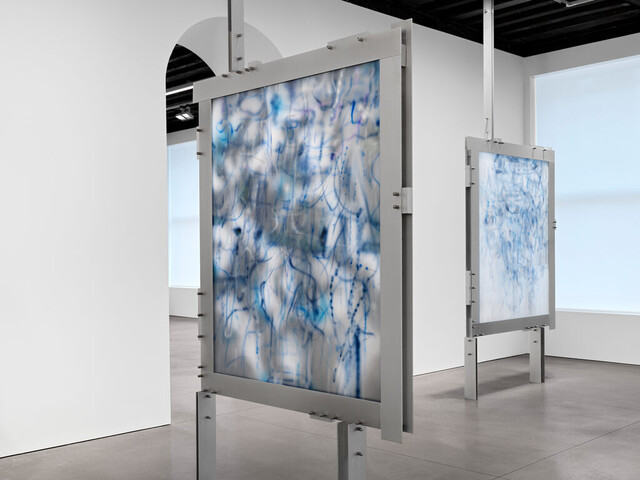
*Our Days, Like a Shadow (a non-abiding hauntology)* presents recent large-scale paintings at Marian Goodman’s Broadway space.3 The subtitle references Derrida’s hauntology — the past doesn’t stay past but haunts the present. The paintings layer architectural plans, maps, news imagery, and gestural marks, each layer partially obscuring the ones below. The effect is archaeological.
Mehretu’s layering method IS palimpsest as artistic practice. Each painting is a site where multiple histories coexist without resolution. The ’non-abiding’ in the title matters: these aren’t stable objects. The layers shift depending on where you stand, how close you get, what catches your eye first.
This connects to everything you think about professionally. Layers of a building’s history, traces of previous uses, the way a BIM model stacks systems. The Derrida hauntology connects to where we’re headed in the reading: the PI is written over and against the Tractatus, which responds to Russell and Frege. And the subtitle’s ’non-abiding’ maps onto the Buddhist thread — impermanence as ground condition.
Lucy + Jorge Orta
Lucy + Jorge Orta are a collaborative duo (Lucy British, Jorge Argentinian) working at the intersection of art, architecture, and social practice. Best known for the Antarctic Village project and OrtaWater (a mobile water-purification system disguised as art).
from root to rain presents textile-based sculptures and installations tracing the journey of water through natural and industrial systems. Materials carry ecological meaning — salvaged fabrics, seed specimens, water filtration components.
The Ortas’ practice is about infrastructure — systems that sustain life but remain invisible until they fail. Their Antarctic Village asked: what does it mean to dwell in a place that doesn’t want you?
The dwelling question in a different register than Gates. The Ortas ask about dwelling under extreme conditions: displacement, ecological crisis. Connects to the Heidegger BDT reading plan from a direction we haven’t explored yet.
Jong Oh
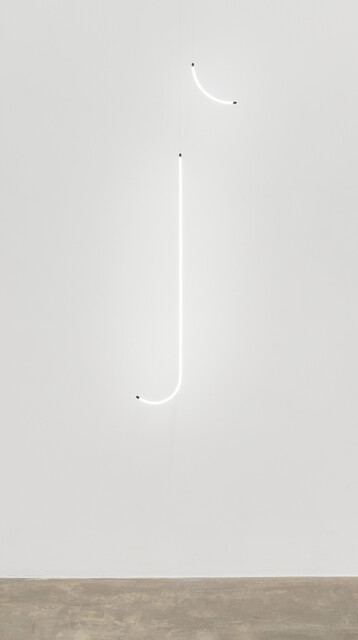
Jong Oh is a Korean-born sculptor working in New York whose pieces are made of thread, metal rods, and thin acrylic panels assembled into structures so minimal they’re easy to miss entirely. His work occupies a territory between drawing and sculpture — the thread functions as a line in space.
Floor and wall pieces that test the limits of visibility. Each sculpture is an exercise in subtraction — how little material can you use and still make a spatial claim? The thread catches light differently from different angles, so the work appears and disappears as you move through the gallery.
Oh’s work is a physical demonstration of attention. It asks: what do you see when you really look? The sculptures don’t demand attention — they reward it. In a culture saturated with visual noise, a sculpture you can barely see is a radical proposition.
This is the Wittgenstein remark I keep coming back to: ’The aspects of things that are most important for us are hidden because of their simplicity and familiarity.’ Oh makes sculpture out of that insight. He’s also the counterpoint to Mehretu on this walk — she layers until the surface overflows; he subtracts until the work nearly vanishes.
- 1. Margaret Curtis: 'S. Post Times · 2026
- 2. Julie Mehretu — Wikipedia. Wikipedia
- 3. Julie Mehretu: Our Days, Like a Shadow (a non-abiding hauntology). Marian Goodman Gallery · 2026