Also Worth
Lower East Side · 6 shows · 3-5 hours · 3 closing ≤14d

Systems of Circulation

Magid’s engraved pennies are still out there. Start with one in your pocket.

Intro
Anchor · Intro · Marc Straus

This walk moves through the LES, East Village, and SoHo following a single thread: how does meaning travel? Not how is it made (that’s the Chelsea walk), but what happens to it once it leaves the maker’s hands?

The anchor is Jill Magid’s *Tender* at Creative Time. During COVID, Magid engraved 120,000 pennies with the phrase ’THE BODY WAS ALREADY SO FRAGILE’ and circulated them through NYC bodegas. The penny’s edge — the only surface free of government imagery — became her intervention site. The pennies are still out there, moving through hands, registers, pockets. They mean something because they circulate, not because they’re displayed. This is a Wittgensteinian artwork in the most literal sense: meaning lives in use, in circulation, not in inscription.

From there, walk to P.P.O.W for Chris DAZE Ellis — a graffiti writer who came up painting subway cars in the 1970s and now shows in galleries. What happens when street art’s meaning changes context? The tag that meant territorial claim underground means something else entirely behind glass. It’s the same marks, different language game.

The Schoelkopf show adds a quieter dimension: American Modernists — Hopper, Hartley, Avery, Sheeler — from a private collection now going public for the first time. Art that lived on someone’s walls for decades, seen only by family and guests, now entering the public record. The private-to-public transition is itself a form of circulation.

Marc Straus’s Intro gathers ten emerging artists in a group show that functions as a snapshot of where things are going. Uffner & Liu’s *Two* and The Hole’s *Neon Moon* fill out the walk with critical-consensus picks — shows that multiple sources flagged as worth seeing. The downtown gallery ecosystem as a circulation system in miniature.

Lower East Side · 6 stops
Walking directions →
The Route · 6 Shows
01 / Marc Straus

Intro

Intro · Marc Straus
299 Grand Street Wed – Sun: 11am – 6pm Mon and Tue by appointment Summer Hours: JUL: Tue – Sat: 11am – 6pm AUG: Open By Appointment Closes Sun Apr 26 Gallery site → Walk to here →
Intro
Who

Group show — ten emerging artists including Lucia Hierro, Edgar Orlaineta, Frank Holliday, and Amy Bravo. Marc Straus Gallery has operated on the Lower East Side since 2010 and specializes in discovering artists before the market catches them. The gallery itself is a form of introduction — hence the title.

What

A survey of ten artists working across painting, sculpture, and mixed media. The show functions as a cross-section of where the LES gallery scene is pointing right now. No single thesis — it’s a sampler, deliberately heterogeneous. Lucia Hierro’s sculptural work on Dominican-American consumer culture stands out as the most conceptually loaded piece in the group.

Why this matters

Group shows are how language games propagate. A gallery’s group show is a curatorial argument about which artists belong in conversation with each other. The introduction isn’t just of each artist individually; it’s of the relationships between them that the gallery proposes.

Connection

Geographic anchor. This show is here because Marc Straus is a good LES starting point and the closing date creates urgency. The intellectual connection is light — but honest: not every show on a walk needs to carry philosophical weight. Some shows are for seeing what you didn’t expect to see.

02 / Creative Time

Tender by Jill Magid

Tender by Jill Magid · Creative Time
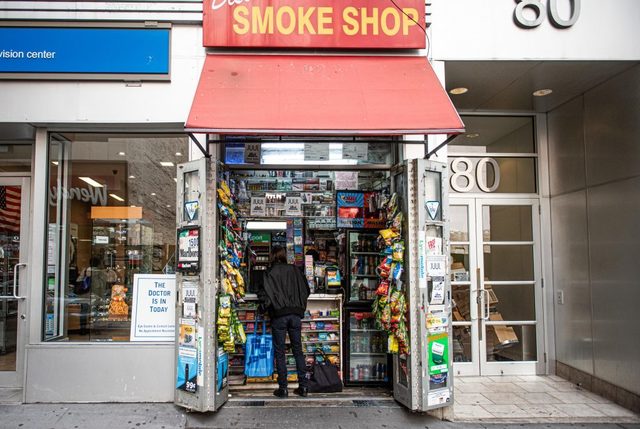
59 East 4th Street Gallery site → Walk to here →
Tender by Jill Magid
Who

Jill Magid is a conceptual artist whose work infiltrates systems of power from the inside.1 She has seduced surveillance networks (persuading the Dutch intelligence agency to let her access their archive), engraved gravestones for living people, and now circulates inscribed currency through the economy. Her method is intimate and institutional at the same time — she works within the grammar of bureaucracy, law, and finance rather than against it. Her lineage runs through Sophie Calle and Andrea Fraser.

What

*Tender* consists of 120,000 pennies engraved on their edges — the only surface free of government imagery — with the phrase ’THE BODY WAS ALREADY SO FRAGILE.’ Magid distributed them through NYC bodegas during COVID. The work has no fixed location: the pennies are in circulation, moving through the economy. At Creative Time, the installation contextualizes the project, but the real artwork is in your pocket, in a tip jar, in a parking meter. The end date is listed as 2047 because that’s when the pennies will theoretically wear smooth.2

Why this matters

This is the most Wittgensteinian artwork in New York right now. Meaning lives in circulation, not inscription. The phrase on the penny doesn’t mean anything sitting in a museum case — it means something when a bodega cashier turns it over in her hand, when a child finds it in a jar, when it passes through a toll. Magid also works at the philosophy-of-technology intersection: she ’seduces systems of power’ by using their own rules against them. The penny’s legal tender status IS the artwork’s medium.

The pennies only mean something because they move through hands, transactions, pockets.
Connection

This is §43 as public art: meaning is use. We’ve been reading Wittgenstein on how a word’s meaning isn’t a mental image but a practice — Magid makes that literal. The penny doesn’t represent fragility; it performs circulation. And her method — working within institutional grammar rather than opposing it — connects to the Heidegger dwelling thread: you don’t build meaning from outside the system, you dwell inside it and reshape it from within.

03 / Uffner & Liu

Two

Two · Uffner & Liu
170 Suffolk Street Tue – Sat 10am – 6pm Gallery site → Walk to here →
Two
Who

Sacha Ingber is a sculptor working with materials that resist easy categorization — plaster, fabric, found objects assembled into forms that hover between abstract sculpture and something almost domestic. Uffner & Liu is a young LES gallery that both Hyperallergic and Two Coats of Paint flagged this month.

What

Two is a focused presentation of Ingber’s mixed-media sculptures. The show received double critical consensus — picked by both Hyperallergic’s monthly roundup and Two Coats of Paint, which rarely overlap. The work focuses on materiality and the tactile, with an emphasis on surface tension between unlike materials.

Why this matters

When two independent critical sources flag the same show, it’s a signal worth following. Critical consensus isn’t the same as popularity — it means different eyes, applying different criteria, arrived at the same conclusion. That convergence is its own form of meaning.

Connection

Geographic anchor + critical consensus. This show is on the walk because the LES clusters well and the double editorial flag earned it a spot. The Connection here is procedural rather than intellectual: the recommendation system working as designed.

04 / The Hole

Neon Moon

Neon Moon · The Hole
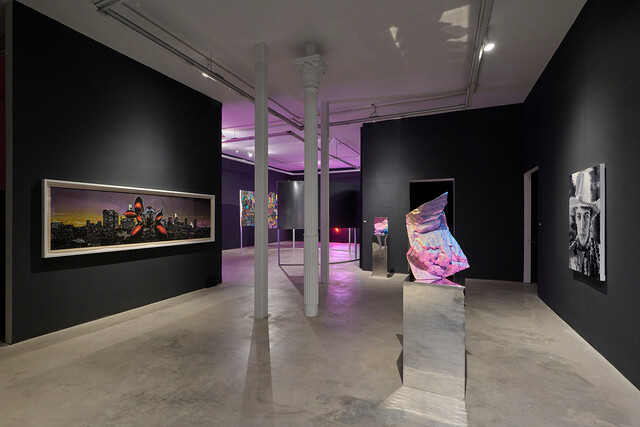
312 Bowery Wed – Sun, 12 – 7pm and by appointment Gallery site → Walk to here →
Neon Moon
Who

Eleven artists including Dan Attoe, Caitlin Cherry, Eric Yahnker, and Michael Staniak. The Hole is a gallery that has built its identity on bridging underground culture and the contemporary art market — a younger, looser energy than the blue-chip Chelsea spaces. They’ve shown internet-adjacent, meme-literate, and subcultural work since opening in 2011.

What

*Neon Moon* is a group show organized around nocturnal imagery, artificial light, and the aesthetics of after-dark. Eleven artists working in painting, digital media, and sculpture. The gallery’s curatorial voice is distinctive — it selects for energy and cultural temperature rather than art-historical lineage.

Why this matters

The Hole operates in a different language game than Gagosian or Pace. Its artists are often younger, less credentialed by traditional measures, and more engaged with digital and subcultural visual languages. Seeing this show after the Schoelkopf American Modernists creates a productive friction: two very different ideas of what ’contemporary’ means, three blocks apart.

Connection

Geographic anchor + market ecosystem contrast. The Hole exists in the same downtown gallery ecology as Marc Straus and Uffner & Liu, but with a deliberately different energy. If the Cooper show in Chelsea is about how a gallery becomes a grammar, The Hole is a reminder that new grammars are always forming.

05 / Schoelkopf Gallery

American Modernism from The Estate of a Private Collector, New York

American Modernism from The Estate of a Private Collector, New York · Schoelkopf Gallery
390 Broadway, 3rd Floor Closes Fri Apr 24 Gallery site → Walk to here →
American Modernism from The Estate of a Private Collector, New York
Who

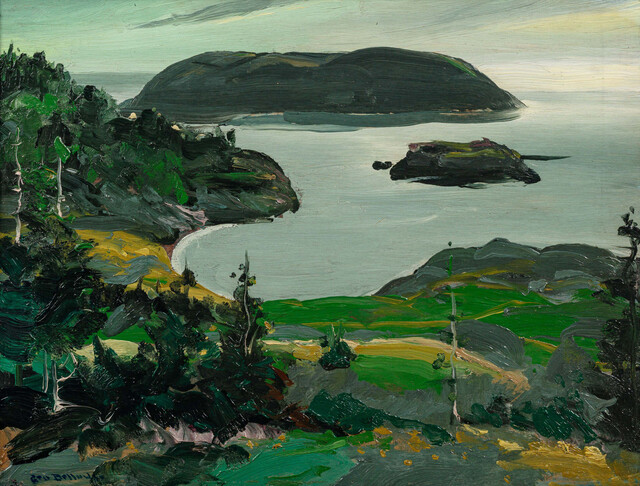
Not a solo show — this is a collection reveal. Hopper, Hartley, Avery, Sheeler, Dove, Stuart Davis), George Bellows, Walt Kuhn — American Modernists gathered by a single collector over a lifetime. Schoelkopf Gallery specializes in exactly this kind of historical constellation: not the flashiest names, but the ones who defined what American painting could be in the first half of the twentieth century. Hartley alone — the painter who made Maine as visually iconic as Cézanne made Provence — is worth the visit.

What

Works from a private New York estate, many unseen publicly.3 The collection maps the arc of American Modernism from Ashcan realism (Bellows) through early abstraction (Dove, Hartley) to Precisionism (Sheeler) and synthetic Cubism (Stuart Davis). Also includes Georgia O’Keeffe and Charles Demuth. Hyperallergic flagged it specifically for the Hartley works. This is a last-chance show — closing April 24, and the collection will likely disperse through auction or private sales afterward.

Why this matters

A private collection going public is a circulatory event. These paintings lived inside one life — on apartment walls, seen by friends and family — and now they enter the public record. The transition from private possession to public viewing changes what the work means, how it’s received, what conversations it can join. It’s the gallery-as-circulation-system made visible.

Art that lived on someone’s walls for decades, now entering the public record.
Connection

This is geographic anchor content — it’s on this walk because Broadway/SoHo clusters well with the LES galleries. But the private-to-public theme does connect: we’ve been talking about how meaning changes with context (§43), and a collection reveal is that principle applied to art ownership. What does a Hopper mean when only one family has seen it for fifty years? Something different than when it hangs in a museum.

06 / P.P.O.W

Orchid Rain on the Underground

Orchid Rain on the Underground · P.P.O.W
390 Broadway Closes Sat Apr 25 Gallery site → Walk to here →
Orchid Rain on the Underground
Who

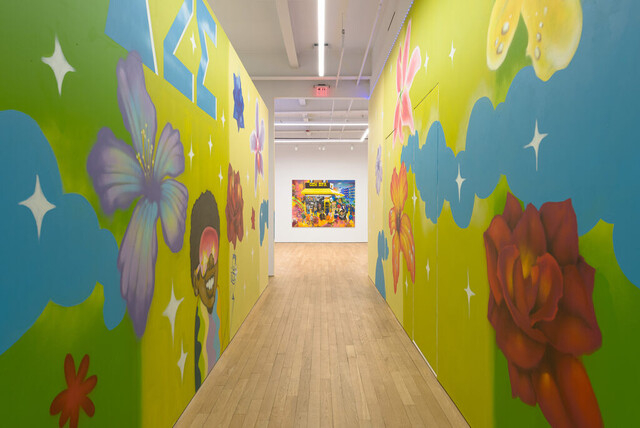
Chris DAZE Ellis began painting NYC subway cars in 1976 at age fifteen.4 He was part of the generation — alongside Basquiat, Keith Haring, Futura 2000) — that brought graffiti from the underground into galleries. Unlike some contemporaries who abandoned their street roots, DAZE has maintained both practices for over four decades. His work moves between painting, murals, and gallery installations, always carrying the kinetic energy of the subway system into whatever context he enters.

What

*Orchid Rain on the Underground* brings DAZE’s recent paintings to P.P.O.W — large-scale works that retain the compositional energy of graffiti (layered text, bold color, architectural fragments) while operating fully as gallery painting. The ’underground’ in the title is both literal (the subway system where he started) and metaphorical (the subcultural networks that formed his visual language). Hyperallergic named it a monthly pick.5

Why this matters

The graffiti-to-gallery trajectory is a live experiment in what Wittgenstein calls a change in language game. The same visual vocabulary — overlapping letterforms, spray-can marks, architectural fragments — meant territorial claim, crew identity, and public defiance on a subway car. In a gallery, it means art-historical reference, market value, and aesthetic experience. Same marks, different game. What changed? Not the object. The context, the use, the form of life surrounding it.

What happens to street art’s meaning when you change its use?
Connection

This maps directly to §43 — ’the meaning of a word is its use in the language.’ DAZE’s work is a physical demonstration: identical visual forms mean different things in different language games. You’ve been thinking about this since §2-3 — the builder’s language where ’slab!’ means something completely different than it would in a philosophy seminar. DAZE is the artist who literally lived that transition.

Sources · 5 references
Verifiable claims, cited
  1. 1. Tender: Public Art Commission. Jill Magid / Creative Time · 2020
  2. 2. Jill Magid's (SMVisS '00) 'Tender'. MIT Art, Culture and Technology · 2020
  3. 3. American Modernism from the Estate of a Private Collector, New York. Schoelkopf Gallery · 2026
  4. 4. Chris DAZE Ellis: Artist Page. P.P.O.W Gallery
  5. 5. Chris DAZE Ellis: Orchid Rain on the Underground. P.P.O.W Gallery · 2026
Walk the Route
Open in Google Maps →